
IMTS 2026: What It Takes to Make Complex Custom Trade Show Exhibits Look Easy
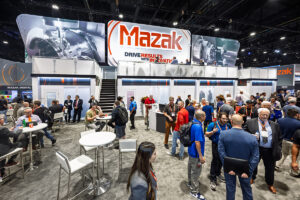
How Downing Displays Plans, Stages, Fabricates, and Manages Multiple Booths for One of the Industry’s Most Complex Events
The International Manufacturing Technology Show (IMTS) 2026 brought 91,295 registrants, 1,788 exhibiting companies, and more than 1.17 million square feet of exhibit space to Chicago’s McCormick Place September 14–19. Attendance increased 2.56% over 2024, and nearly 400 companies exhibited for the first time. (Source: TSNN: IMTS 2026 Saw an Increase in Attendance, Plus More Interest in Specialty Programming)
Downing Displays supported four significant client exhibits: Mazak, JAYCO, LNS, and Blum-Novotest. Asked how the show went, Account Executive Matthew Ward offered an answer every exhibit team hopes to hear: “It went so smoothly, it was almost boring.” That may sound uneventful. At a show as large and operationally complex as IMTS, it is anything but.
Smooth execution is rarely the result of nothing happening. More often, it reflects everything that happened before the show opened: planning, revisions, custom exhibit fabrication, staging, coordination, testing, troubleshooting, and anticipating what could go wrong while there is still time to fix it.
Custom Exhibit Fabrication Starts Long Before the Show Floor
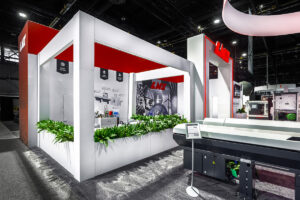
For the Downing Displays team, much of the work behind IMTS took place in Milford, Ohio. The team assembled and staged major custom trade show exhibits in advance inside Downing Displays’ 140,000-square-foot headquarters, where they could review structures, graphics, lighting, functional elements, and overall execution before shipping them to McCormick Place. (You can see this in action in our recent aerial facility tour.
That advance staging is particularly valuable for complex exhibits. A rendering can show what an environment should look like. A full build reveals how it actually works. Are the graphics aligned correctly? Are sightlines right? Does the lighting perform as expected? Do doors clear surrounding structures? Is equipment positioned correctly? Can technology be accessed and serviced? Are there details that look fine on paper but create problems once the pieces come together?
Addressing those questions in Milford is far easier than discovering them during installation in Chicago. For several of the Downing Displays IMTS projects, that advance preparation was a major reason show-site execution could feel uneventful.
Blum-Novotest: Designing Around the Details
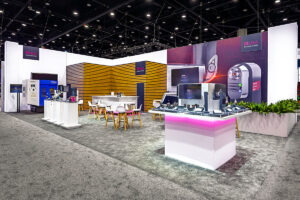
Kraig Holmes’ Blum-Novotest project shows how much can go into a finished show-floor environment. The 30′ × 50′ custom inline rental exhibit, positioned as a corner configuration, included 16-foot walls, real wood finishes, product demonstration areas, soft seating, a 100-inch display, hospitality space, and integrated technology.
But some of the most important work was almost invisible. The exhibit included a sink, dishwasher, large refrigerator, additional refrigeration, storage, and workspace to support a substantial hospitality program. Because the plumbing drain was outside the service area, the team designed a roughly four-inch raised-floor section that let drainage lines run beneath the finished exhibit, avoiding visible obstructions across the floor.
That solution mattered for more than appearance. The Blum team had experienced plumbing and drainage problems at an earlier show. Downing Displays incorporated those lessons into the new plan. Plumbing connections were tested before the raised flooring and surrounding structures were completed, allowing the team to confirm that the system was functioning properly before access became more difficult. That is the kind of detail attendees never notice when it works. They simply see a polished exhibit.
Complex Installations Require More Than a Good Design
IMTS also creates operational complexity that has little to do with square footage. McCormick Place involves multiple service providers and tightly controlled jurisdictional work. Electrical, flooring, rigging, technology, utilities, and other services may involve different teams that must work in the right sequence.
Holmes described the coordination as a constant process of making sure one service was completed in time for the next. The Blum exhibit added another layer: large manufacturing equipment with substantial electrical and compressed-air requirements. Equipment had to be positioned directly on the concrete, while carpet, padding, electrical runs, and air lines were carefully coordinated around it.
The finished environment may look simple to an attendee walking by. The work behind that simplicity is not.
Coordination Before the Crew Arrives
One of the less visible parts of Downing Displays’ process happens before installation begins. For complex custom trade show exhibits, the team reviews the project with show-site supervisors and installation partners in advance, discussing the structure, potential obstacles, client expectations, and anything unusual about the build.
For Blum, that meant ensuring the installation team understood both the exhibit’s technical complexity and the client’s expectations before arriving on the show floor. According to Holmes, that advance coordination made a noticeable difference. The client saw a crew that arrived already familiar with the project rather than learning it in real time.
Dedicated preparation also supports something clients value enormously at a major show: confidence. When a question or issue arose, the Blum team knew someone from Downing Displays was nearby and prepared to address it.
Four Exhibits, One Downing Displays Team
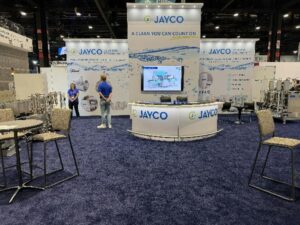 Responsiveness extended beyond any single client. Downing Displays had account executives, supervisors, and installation partners supporting multiple exhibits across IMTS. While each account had its own team and priorities, the group operated as a broader Downing Displays presence on the show floor. When something needed attention, resources could shift. Holmes described supervisors moving between exhibits, checking progress, holding crews accountable, and responding quickly when something required attention, regardless of whose account it technically belonged to.
Flexibility matters at a show the size of IMTS, where an issue in one hall cannot always wait for the person originally assigned to it to become available. It also helps explain Matthew Ward’s description of the week as almost boring. Nothing major went wrong. Nothing significant was missing. Nothing was broken. The work became staying on top of dozens of details and keeping each program moving. That is not luck; it’s preparation doing its job.
The Best Successes Are Proactive Solutions to Problems No One Else Saw Coming
Trade show success is often measured by what attendees see: the exhibit, the demonstrations, the conversations, and the activity happening inside the space. A custom trade show exhibit company also has to think about everything attendees never see. Drainage. Power. Air lines. Door clearances. Flooring transitions. Graphics. Storage. Crew timing. Service-provider coordination. Equipment placement. Installation sequence. What happens if something changes on site.
The goal is not to eliminate every variable. That is impossible. The goal is to understand enough in advance that, when something does happen, it can be handled without becoming the client’s problem.
For Downing Displays, IMTS 2026 was a strong example of that principle at scale. Four client exhibits. Extensive advance staging in Milford. Multiple teams and show partners. Complex technical requirements. Thousands of individual details. By the time the show opened, it felt remarkably smooth.
Sometimes “boring” is exactly what success looks like.
Planning a major 2027 or 2028 show?
Contact Downing Displays to start the conversation early.
See More From IMTS 2026
Explore the Downing Displays exhibits featured at IMTS 2026:
IMTS 2026 by the Numbers
Read TSNN’s post-show coverage for additional perspective on IMTS 2026 attendance, exhibitors, and specialty programming.
Frequently Asked Questions About Custom Trade Show Exhibits
What should I look for in a custom trade show exhibit design and fabrication company?
Look for a partner that can connect strategy, design, custom exhibit fabrication, staging, logistics, and show-site execution. Complex exhibits benefit from a team that can test major elements in advance, coordinate with show-service providers, identify potential operational issues, and support the project through installation rather than handing it off after fabrication.
How does a trade show exhibit company manage complex installations and prevent problems at the show?
Preparation is the biggest factor. A strong process includes detailed planning, advance staging, testing electrical and utility requirements, coordinating installation partners, reviewing likely obstacles, and having experienced supervisors on-site. The goal is to identify as many problems as possible before the show and respond quickly to anything that changes during installation.
Can one exhibit company manage multiple trade show exhibits or events at the same time?
Yes, as long as the company has the capacity, processes, and on-site resources to support multiple programs simultaneously. At IMTS 2026, Downing Displays supported four client exhibits while coordinating account teams, supervisors, installation partners, and show services across McCormick Place.
Get more answers to more questions