
Who Needs Support for International Trade Shows

International trade show support is essential for U.S. companies operating in unfamiliar markets. This includes organizations in industries like manufacturing, industrial equipment, and life sciences that are expanding into global markets and participating in major international events like Hannover Messe, MEDICA, Farnborough, and ADIPEC, or managing multi-country exhibit programs. It is especially important for larger-scale exhibits — island booths, double-deck structures, and multi-inline environments — where the complexity of delivering a consistent experience across international markets increases with exhibit size.

For smaller programs attending a single international show, the coordination and local knowledge requirements are just as real. Even if the logistics volume is lower, international exhibiting is not a simple task. It is a scaled-down version of the same set of unfamiliar variables.

Explore All Exhibitor Services
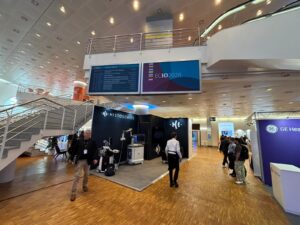
 

international trade shows - Histosonics booth

Why International Shows Are More Complex for U.S. Exhibitors

The most consequential mistakes U.S. exhibitors make at international shows do not stem from shipping or logistics failures, largely because assets are typically built or rented in-country. More often, failures come from not understanding how markets operate. Here are some of the top differences:

  • Shell scheme regulations differ significantly from U.S. standards: in Europe, booth sides can extend the full height of the structure to the aisle edge, creating three solid walls on a standard space — a configuration not permitted in the U.S.
  • Raised floors are standard practice at many European trade fairs, not a premium upgrade. U.S. exhibitors who do not anticipate this and plan for the carpeting they are more familiar with arrive unprepared.
  • Audience expectations can also differ. Messaging that resonates in the U.S. may not translate directly. Interaction styles, pacing, and engagement norms vary across regions. International programs do not fail because of design; they fail when execution and cultural adaptation break down simultaneously.

These are not edge cases. They are standard features of the markets where many of the world’s largest trade fairs are held. Exhibitors who have not worked internationally before often do not know what they do not know. That gap is where programs fail.